Always Rushing? A Memoir on How I Learned to Slow Down and Stop Living Life on the Edge.
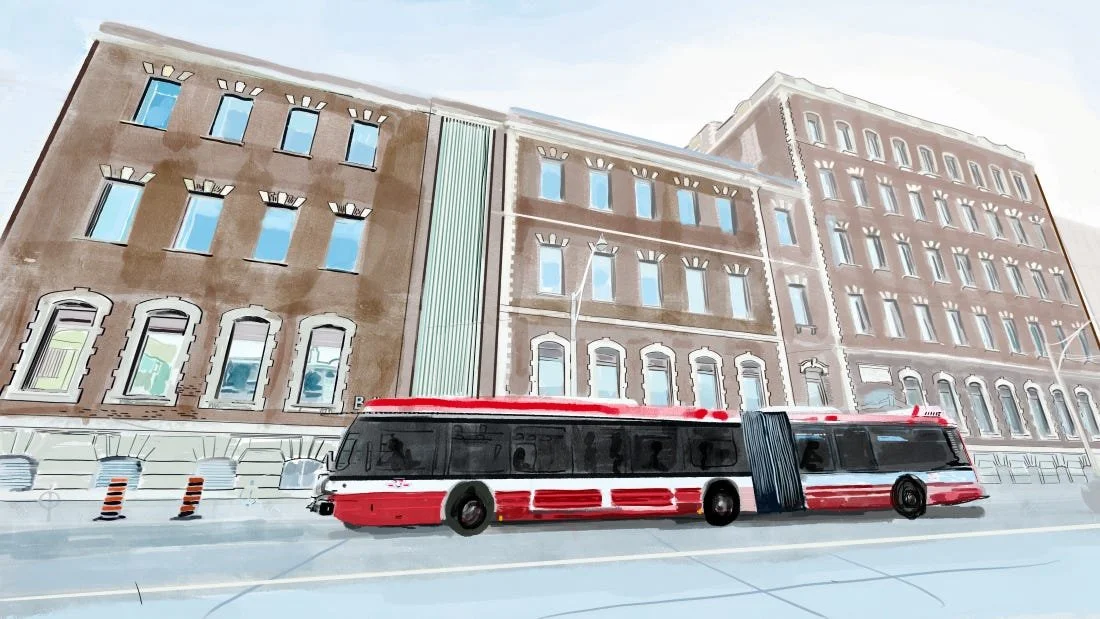
Memories of Toronto © (Original Artwork by me not for reproduction without a license) shows the Bell Building Outside Dufferin Station. Alt Text: Illustrated urban street scene featuring a red and white articulated city bus in motion, with historic brick buildings and traffic cones in the background.
If you’ve ever messed up real badly because you were late to something extremely important to your career or credibility, you know what I mean.
I was determined to change this side of me but it was far from easy. (Side note: If you’ve dealt with trauma growing up, you’d have been guilted into abandoning yourself. A part of you can get addicted to guilt and adrenaline, because you don’t feel alive otherwise. So this had a part to play in it too. I’ll write about this in another post)
The first thing I realized was, I was always rushing. Rushing to get ready, rushing for the bus, rushing to work, rushing while waiting for the elevator. It became a norm.
And this also changes your breathing. When you’re rushing, you’re not really calm. You breathe heavy and your heartbeat rises.
I remember this time I would go to these gnosis classes and I needed to take a bus to get to the train station.
There are 4 stages to personal improvement I learnt in my coaching certification.
1. Unconscious incompetence (as-is state/blind spots, shadow side)
2. Conscious incompetence (becoming aware of your shortcomings)
3. Conscious competence (working actively to improve)
4. Subconscious competence (making it second nature)
Now if you want to get better in any area, you need to first become of your incompetence. Humans are perpetually in stage 1, until then become conscious of the thing they do and become conscious about their delta.
So going back to the bus. I decided “okay so we’re gonna go to the bus station and we’re gonna get there early, now if you see a bus, let it go, don’t worry. Don’t rush. We can take the next one.” and resolved to slow down.
Now what we don’t realize is ‘knowing’ and ‘doing’ are poles apart, and we need to close the gap. The average of you will determine what you “do”, in-spite of what you “know”.
1. UNCONSCIOUS INCOMPETENCE.
You cannot will yourself into changing by deciding in the mind what you’ll do. Well not yet anyway, it’s possible to use your will with consciousness and unlock inner magic, but more on that later.
So we’re walking to the bus station, we see the bus, and the body’s autopilot kicks into action and the next thing we know, the heartbeat rises and we’re rushing to cross the street at the lights, and getting into the bus before it leaves. But, but. Didn’t we ‘decide’ something else before we left? We said we’d slow down and that we’d let the bus go, if it meant rushing to grab it.
2. CONSCIOUS INCOMPETENCE - I BECAME AWARE OF MY INCOMEPTENCE
Believe me you, it was not easy to slow down, because I had a lifetime of rushing that was stored in my neurons. That’s how neurons work. There’s a layer of fat called Myelin that is formed between neurons that fire together often. Humans are electro magnetic beings and the neurons pass information using electricity. When you act a certain way often, the body creates pathways to conduct electricity in those parts faster and faster each time, so the layer of fat helps facilitate that process. We’re trying to reprogram our neurons. A mighty task, you see, not for the weak of mind.
Now you’d think now that I knew all of this it I would do it the next time I was taking the bus. But no.
Another thing I learnt, is these things take time and you can’t reprogram your habits in a day. It will take time, like building physical muscle, you build the mental muscle. As within, so without they say.
Realistically, and honestly, it took me more than a few months to slow down and be willing enough to let go of the bus. It’s easy to live from a mindset of scarcity. “What if the next bus is 15 minutes late, speaks the devil’s advocate and you don’t realize how soon the neurons start to fire together and influence the body’s actions. It happens below the conscious level.
It took me a long time to become conscious of the fact that I was rushing.
My next task: To walk; not run, or brisk walk, or sprint while walking to the bus stop. I calmly and gracefully take the bus and board in peace.
Breathing awareness (remind me later: raja yoga, pranayama, consciousness) is absolutely essential. When you rush you breath faster. You can improve both from inside and outside. As you slow down your body and your legs, you can also first become conscious of your breathing, and slow down the breath). And of-course I’m condensing several months worth of personal experiments in this small paragraph.
We’ve spent so long going away from ourselves, that we keep losing focus all the time; we space out but we don’t realize we’re doing it.
The other thing I did that supplemented my entire journey was breathing meditation, and breathing awareness. Which is, starting to become aware of your breath whenever you can.
It’s a way to anchor yourself (marrying the inner Shiva with Shakti.) Shiva is your consciousness and your body is shakti and prakriti.
When your consciousness grows roots in your body, you can break habit patterns and loops.
I don’t believe humans were always like this. I think our ability to focus atrophied and if you observe yourself, you’ll realized, from minute to minute you keep spacing out. (for later: self-remembering and other tools for the evolution of consciousness). If you can’t focus on the present moment, you cannot focus on your auto-pilot when it takes over, like in my case where I precisely decided my course of action but when I saw the bus, my autopilot took over.
The autopilot is made of the actions you repeat day in, day out and then it moves to a deeper part of you that can function without your conscious knowledge.
The next stage was consciously working on slowing down. This is chopping the wood and getting the water kinda stage. Image you’re karate kid studying under a kungfu master, and all he asks you to do is chop the wood and carry the water (a Zen Buddhism quote. This is CONSCIOUS COMPETENCE. It’s the tedious part of going to the gym and lifting the weights to build muscle.
Similarly, the longest time will be spent in conscious competence the third stage and most people give here. It’s because it’s difficult to see yourself fail again and again. Imagine trying to break a habit for over 2-3 years and seeing yourself fail hundreds of thousands of times. The ego will want to forget this knowledge and go back to the old ways.
While doing this, there were other things I did that helped me, and I learnt it from my ex-roomate Jaspreet who used to make a list before she went anywhere.
I created this ritual where I would write down in my phone’s notepad, the morning of the task or the night before:
Wake up at ____
Start getting ready at ____
Shower at ____
Wear shoes at ____
Leave home at ____
Get to the bus station at ____
Transfer to so and so train at ____
And I used google maps to plan this out. There’s an option to choose “arrive at” and I’d add a 15 buffer so I didn’t have to worry if there were unexpected delays.
I realized that as someone who’s a curious creative neuro-divergent, I always had a lot going on. I couldn’t execute tasks simply by thinking them in my mind.
When I wrote them down, it helped reinforce the plan and it’s almost like talking to a coach about your plan.
I also spent time journaling at the end of the day, and the plan for the next day would help me remember the next day what I was supposed to do.
When you talk to yourself through paper, it helps you plan your goals. If you struggle to following through on your plans, start writing down what you have to do. And if you can’t complete your list, that’s fine, move it to the next day.
Slowing down by becoming conscious that I was rushing, working actively and practically on walking to my stop as opposed to running, being aware of my breath, and making a note of my day’s plan, were all a part of my conscious competence stage.
Now it’s a core trait, some might even argue it’s a permanent trait to be late. If you’ve ever seen Einstein’s desk, you’d know: always in disarray. And yes I was like this even when I was 3 or 4 years old. I’d always be late to school. But that doesn’t excuse you from working on managing being late. I’m sure there are neuro-divergent people in Japan but somehow the whole country manages to be on time.
(Einstein’s desk. If yours is just as messy, congrats you share something in common with a genius)
This does not mean that I have fixed myself and I’m never late now. But if I was at a 5 before I’m at a good 8.5 in terms of the improvements I’ve made to carve an intentional existence.
Slowing down also helps us focus, and meditation is nothing but sharpening our ability to focus.
There’s a way to meditate while sitting stationery in one place, and there’s a way of meditating while keeping your eyes open. Practical spirituality is more important than reading books and understanding concepts.
Even 10 years of reading how to drive a car won’t actually let you drive a car.
We’re a sum average of who we’ve always been. If you want to improve, to learn, or get better at something, you have to change the average of you. And it’s a slow process, you chip away at the boulder, bit by bit. You cannot rush your evolution.
The last thing I’ll tell you is that we all have an inner voice. It is like an inner parent who reminds you while you’re scrolling on your phone that you have to get up and get ready. It will also remind you when it’s too late and you’re constantly having an inner dialogue with this voice inside of you. “go shower you now you gotta go do that that thing” “yeah, yeah I’m going to go do it after I’m done watching this reel, or this episode” you say to the voice, and continue to snooze it. What happens to an alarm that you keep snoozing? You don’t even realize you’ve snoozed it because you’re teaching your body that it’s not important.
I cannot stress how important it is to reconnect with your body’s wisdom and make amends with this inner parent, because it’s the key to your success. If you have an unruly inner child who keeps getting distracted, you have to gently hold it’s hand and go do that thing.
This is sort of the final stage of growing up where you take full responsibility for your self-improvement and stop blaming others for what they did to make you that way. Yes they did but we can’t spend our the rest of our lives living a subpar existence because of what your parents did, or what they didn’t teach you.
Teach yourself how to do it now. You’re your responsibility now.
So, are you ready to take that step?
